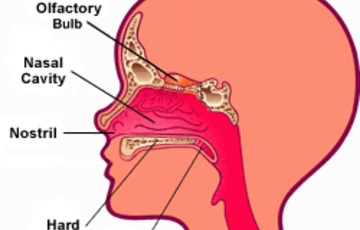
DIAGRAM OF THE HUMAN NOSE: November 2025

Anatomy and the Human Blockhead


Anatomy and the Human Blockhead

🧠 The Anatomy Behind the Illusion

1. The Nasal Cavity Is Deeper Than It Looks

Inside the nose is a long, air-filled chamber that extends straight back toward the throat. When you look at someone’s nostrils from outside, it seems like the space ends quickly—but it actually continues much further back in a straight line.

  • The average adult nasal cavity is 7–8 cm (about 3 inches) deep.

  • It’s shaped like a tunnel, not an upward turn the way people often imagine.

This is the space a performer uses.


2. What the Performer Is Not Doing

  • They are NOT piercing bone.

  • They are NOT entering the brain (the “brain through the nose” myth).

  • They are NOT going anywhere near the skull plate between the nasal cavity and the brain.

The nail simply follows the natural path of the nasal passage.


3. Why It Looks So Dramatic

  • Most people assume the nose turns upward right away, so the straight-back direction feels wrong.

  • The object is long, rigid, and looks like it must be going into solid bone, but it isn’t.

  • The performer’s facial expression (remaining calm) enhances the illusion that something impossible is happening.


4. Why Performers Can Do It Safely (After Training)

Professional performers:

  • Understand nasal anatomy precisely.

  • Know how to avoid delicate structures like blood vessels and mucous membranes.

  • Build tolerance over time.

  • Use sterile objects and proper hygiene.

  • Know how to stop if they hit resistance or irritation.


⚠️ Important Safety Note

Although the stunt is based on real anatomy, it is not safe for untrained individuals. Attempting it can cause:

Professional sideshow performers train for months or years under experienced supervision.


OTHER SOURCES

THE HUMAN NOSE

The human blockhead act is a trick that relies on the structure of the human skull

The skull is a collection of 22 bones, most of which are fused together at joints called sutures

These fused bones form a covering that protects your brain. Although much of the skull looks like one solid piece, it's also full of holes and spaces. 

These include the sinuses, the eye sockets and the foramen magnum, where the brain stem exits the skull.

The human nasal cavity

The physical features in a person's face are the result of the way skin, fat and muscle tissue lie over this bony structure. An exception is the human nose. The external portion of the nose is mostly cartilage and connective tissue covered with skin. Hair and mucous line the nose and protect the interior nasal passageways from dust, debris and other foreign substances.

The external portion of the nose is a little deceptive. Two nostrils appear to lead almost straight up into the nasal passageway. In reality, the nasal cavity, which connects the nose to the throat, leads almost straight back. Its ceiling is approximately even with the top of the nose, just below the eyes. Its floor tends to be almost level with the alar cartilage, which forms the openings for the nostrils.

The nasal cavity isn't entirely smooth and straight. Its walls are made up of several grooves known as conchae. These grooves hold on to moisture when you exhale through your nose, which helps keep your nasal passages from drying out. Mucous membranes line all of these surfaces, providing lubrication and protection.

Diagram of the Human Nose

Anatomy and the Human Blockhead Video :


Anatomy and Physiology of the Nose and Throat


Anatomy and Physiology of the Nose and Throat

What is the human nose?

The human nose is the organ of smell located in the middle of the face. The internal part of the nose lies above the roof of the mouth. The human nose consists of:

  • external meatus - triangular-shaped projection in the center of the face.
  • external nostrils - two chambers divided by the septum.
  • septum - made up primarily of cartilage and bone and covered by mucous membranes. The cartilage also gives shape and support to the outer part of the nose.
  • nasal passages - passages that are lined with mucous membranes and tiny hairs (cilia) that help to filter the air.
  • sinuses - four pairs of air-filled cavities, also lined with mucous membranes.

What are sinuses?

The sinuses are cavities, or air-filled pockets, near the nasal passage. As in the nasal passage, the sinuses are lined with mucous membranes. There are four different types of sinuses:

  • ethmoid sinus - located inside the face, around the area of the bridge of the nose. This sinus is present at birth, and continues to grow.
  • maxillary sinus - located inside the face, around the area of the cheeks. This sinus is also present at birth, and continues to grow.
  • frontal sinus - located inside the face, in the area of the forehead. This sinus does not develop until around 7 years of age.
  • sphenoid sinus - located deep in the face, behind the nose. This sinus does not develop until adolescence.
 What is the throat?

The throat is a ring-like muscular tube that acts as the passageway for air, food, and liquid. The throat also helps in forming speech. The throat consists of:

  • larynx - also known as the voice box, the larynx is a cylindrical grouping of cartilage, muscles, and soft tissue which contains the vocal cords. The vocal cords are the upper opening into the windpipe (trachea), the passageway to the lungs.
  • epiglottis - a flap of soft tissue located just above the vocal cords. The epiglottis folds down over the vocal cords to prevent food and irritants from entering the lungs.
  • tonsils and adenoids - made up of lymph tissue and are located at the back and the sides of the mouth. They protect against infection, but generally have little purpose beyond childhood.
Diagram of the Human Nose , Anatomy and Physiology of the Nose and Throat : 


The Nose


The Nose

1. Overview

The nose is the primary organ for breathing and smelling. It also filters, warms, and humidifies the air before it reaches the lungs. It is divided into:

  • External nose – the visible part on the face.

  • Internal nose (nasal cavity) – the hollow space inside.


2. External Nose

  • Nasal bridge: The bony upper part of the nose.

  • Nostrils (nares): Openings for air entry.

  • Nasal tip: The protruding end of the nose.

  • Ala: The rounded flared sides of the nostrils.

  • Columella: The tissue separating the two nostrils.


3. Internal Nose (Nasal Cavity)

  • Nasal septum: Divides the nasal cavity into right and left sides; made of bone and cartilage.

  • Nasal conchae (turbinates): Superior, middle, inferior – bony curves that increase surface area for air filtration, warming, and humidification.

  • Meatuses: Air passages beneath each concha.

  • Olfactory epithelium: Located at the top; contains smell receptors.

  • Respiratory epithelium: Lining most of the cavity; secretes mucus to trap particles.


4. Sinuses (Paranasal Sinuses)

Hollow spaces connected to the nasal cavity:

  • Frontal sinus – above the eyes.

  • Maxillary sinus – in the cheeks.

  • Ethmoid sinus – between the eyes.

  • Sphenoid sinus – deep behind the ethmoid sinuses.


5. Functions

  1. Breathing: Passageway for air to reach lungs.

  2. Smelling: Houses olfactory receptors.

  3. Air conditioning: Warms, humidifies, and filters inhaled air.

  4. Resonance: Contributes to voice sound.

  5. Protection: Traps dust, microbes, and other particles with mucus and cilia.


The nose is the body's primary organ of smell and also functions as part of the body's respiratory system.

Air comes into the body through the nose. As it passes over the specialized cells of the olfactory system, the brain recognizes and identifies smells. Hairs in the nose clean the air of foreign particles. As air moves through the nasal passages, it is warmed and humidified before it goes into the lungs.

The most common medical condition related to the nose is nasal congestion. This can be caused by colds or flu, allergies, or environmental factors, resulting in inflammation of the nasal passages. The body's response to congestion is to convulsively expel air through the nose by a sneeze.

Nosebleeds, known medically as epistaxis, are a second common medical issue of the nose. As many as 60 percent of people report nosebleed experiences, with the highest rates found in children under 10 and adults over 50.


diagram-of-human-nose.

DIAGRAM OF THE HUMAN NOSE-3


DIAGRAM OF THE HUMAN NOSE-3

Here’s a clear textual breakdown of a diagram of the human nose (I can also generate an actual labeled image if you want):

1. External Nose (visible part):

  • Nasal bridge: The upper bony part of the nose.

  • Nostrils (nares): Openings for air entry.

  • Nasal tip: The pointed end of the nose.

  • Ala (plural: alae): The flared sides around the nostrils.

  • Columella: Tissue that separates the two nostrils.

2. Nasal Cavity (internal):

  • Nasal septum: Divides the nasal cavity into right and left sides; made of cartilage and bone.

  • Nasal conchae (turbinates): Three curved bony structures (superior, middle, inferior) that increase surface area for warming and humidifying air.

  • Nasal meatuses: Passages beneath each concha for air flow.

  • Olfactory epithelium: Located at the top of the nasal cavity; responsible for smell.

  • Respiratory epithelium: Lines most of the nasal cavity; contains mucus-secreting cells.

3. Sinuses (connected to nasal cavity):

4. Nasopharynx (back of nasal cavity):

VIDEO:


What diseases or disorders can the nose have?


What diseases or disorders can the nose have?

The human nose, including the nasal passages and sinuses, can be affected by a wide variety of diseases and disorders, which are generally categorized as infectious, inflammatory/allergic, structural, or cancerous.


🦠 Infectious and Inflammatory Conditions

These are the most common disorders and often involve the surrounding sinus cavities (rhinosinusitis).

  • Common Cold (Acute Viral Rhinitis): A viral infection causing inflammation of the nasal lining, leading to runny nose (rhinorrhea), congestion, and sneezing.

  • Sinusitis: Inflammation of the mucous membrane lining the paranasal sinuses.

    • Acute Sinusitis: Usually follows a cold and is caused by viruses or bacteria.

    • Chronic Sinusitis: Inflammation lasting 12 weeks or longer, often due to persistent infection, allergies, or nasal obstruction.

  • Allergic Rhinitis (Hay Fever): An allergic reaction to airborne particles (pollen, dust mites, pet dander). It causes persistent sneezing, itching, watery eyes, and clear nasal discharge.

  • Nasal Polyps: Soft, painless, non-cancerous growths on the lining of the nasal passages or sinuses, often linked to chronic inflammation or asthma. They can block airflow and reduce the sense of smell.

  • Epistaxis (Nosebleeds): Usually caused by trauma, dryness, or hypertension, resulting from broken blood vessels in the nasal septum.


🏗️ Structural and Mechanical Issues

These conditions affect the physical architecture of the nose, often leading to breathing difficulties.

  • Deviated Nasal Septum: A shift of the wall of cartilage and bone (septum) that divides the nasal cavity in half. A severe deviation can obstruct one or both nostrils, making breathing difficult and contributing to snoring or sleep apnea.

  • Turbinate Hypertrophy: Enlargement of the turbinates (conchae), the structures inside the nose that regulate airflow. This is often caused by chronic allergies or inflammation and can lead to significant nasal blockage.

  • Nasal Valve Collapse: Weakness or narrowing of the nasal valve area (the narrowest part of the nasal airway), causing the nostril to collapse inward during inhalation.


👃 Olfactory and Sensory Disorders

These conditions affect the sense of smell and the sensory experience of the nose.

  • Anosmia: The complete inability to smell. It can be temporary (due to a cold or infection) or permanent (due to nerve damage, head trauma, or chronic sinusitis).

  • Hyposmia: A reduced ability to smell.

  • Phantosmia: Smelling an odor that is not actually present (olfactory hallucination), often due to neurological issues.


malignancy and Rare Conditions

Though less common, tumors can also affect the nasal and sinus areas.

  • Nasal and Sinus Cancer: Malignant tumors that form in the tissues of the nasal cavity or paranasal sinuses. These are rare but often present as persistent blockage, chronic sinusitis-like symptoms, or nosebleeds.

  • Inverted Papilloma: A non-cancerous (benign) tumor that can grow inward from the nasal lining. While benign, it is destructive and has a high rate of recurrence and a small potential to become cancerous.


THE HUMAN NOSE

One disored that your nose may have is a deviated septum- this is where the bone that splits your nostrils is skew; either because it grew that way or you broke your nose. This can create a blockage in your nose, making it difficult to breath.

Another disored is small nostrils; this also makes it difficult to breathe and can be a cause of snoring. It is also a sign of cancer so see you docter straight away before its to late.
Diagram of the human Nose.

What diseases or disorders can the nose have? A Video :


TWIN PATHWAYS INTO THE BRAIN


TWIN PATHWAYS INTO THE BRAIN

The phrase "Twin Pathways into the Brain" generally refers to the two main types of nerve fiber tracts that carry information into the Central Nervous System (CNS—the brain and spinal cord) from the body and the environment: the Sensory (Afferent) Pathways and the Special Sense Pathways.

However, in the context of general brain function, this phrase is often used specifically to describe the two major ascending sensory pathways that bring touch, pain, temperature, and body position information from the body up to the Somatosensory Cortex in the parietal lobe.


1. Sensory Pathways (Somatic Sensation)

These two primary pathways are responsible for all touch, pain, temperature, and joint position information.

A. Dorsal Column-Medial Lemniscal Pathway (DCML)

  • Information Carried: Fine touch (discriminative touch), vibration, and proprioception (awareness of body position and movement).

  • Speed: This is the faster pathway, necessary for rapidly transmitting precise, detailed information.

  • The Cross: The fibers travel up the spinal cord on the same side (ipsilateral) they entered until they reach the medulla in the brainstem, where they cross over (decussate) to the opposite side.

  • Function: Essential for tasks requiring high spatial resolution, like recognizing an object by touch without looking (stereognosis).

B. Anterolateral (Spinothalamic) Pathway

  • Information Carried: Pain, temperature, and crude (non-discriminative) touch.

  • Speed: This is the slower pathway, as the information is not as urgently detailed.

  • The Cross: The fibers cross over (decussate) immediately upon entering the spinal cord at that level, and then travel up the opposite side (contralateral) to the brain.

  • Function: Critical for survival and reflexes, alerting the brain to potentially harmful stimuli.


2. General Input Pathways

More broadly, all information reaching the brain falls into these two categories:

A. Somatic and Visceral Sensory Pathways

This includes the DCML and Spinothalamic pathways mentioned above, carrying information from:

  • Soma (Body): Skin, muscles, and joints (touch, pressure, pain).

  • Viscera (Internal Organs): Information about internal states (e.g., blood pressure, digestive discomfort).

B. Special Sensory Pathways

These are dedicated pathways from the specialized sense organs, each with a unique neural route:


Diagram of the Human Nose

The centimeter-long human vomeronasal organ (VNO), shown sliced in two in the photograph below acts as a sensor for airborne human pheromones-odorless molecules that influence sexual desire and other feelings. The molecules set off signals that are transmitted through the VNO nerves (red) directly to the hypothalamus. Smell messages travel through the parallel olfactory system (blue) to a different part of the brain...(diagram of the human nose)

TWIN PATHWAYS INTO THE BRAIN : VIDEO


Diagram of The Human Nose


Diagram of The Human Nose-2

The Human Nose: Anatomy and Function

The human nose is a complex structure that serves as the entry point for respiration and the organ for the sense of smell (olfaction). It's internally divided into two nasal passages by the septum.


Key Anatomical Components

  1. External Nose: The visible portion supported by the nasal bone (at the bridge) and flexible cartilage (forming the tip and nostrils, or nares).

  2. Nasal Cavity: The large, internal, air-filled chamber separated by the Nasal Septum (a wall of bone and cartilage).

  3. Nasal Conchae (Turbinates): Three pairs of curved, shelf-like bones that project into the nasal cavity (superior, middle, and inferior). They increase the surface area and create air turbulence to ensure inhaled air touches the lining.

  4. Mucous Membrane: The lining of the nasal cavity is rich with blood vessels and secretes mucus to trap particles and moisturize the air. It also contains cilia (tiny hairs) that sweep mucus toward the throat.

  5. Olfactory Epithelium: A specialized patch of tissue high in the roof of the nasal cavity. It contains the olfactory receptor cells—the sensory neurons that detect odor molecules.

  6. Paranasal Sinuses: Air-filled cavities within the bones of the skull (frontal, ethmoid, sphenoid, and maxillary) that connect to the nasal cavity and help lighten the skull and resonate the voice.


Primary Functions

  • Respiration (Air Conditioning): The turbinates and mucous membranes filter (trapping dust), warm (by blood vessels), and humidify (by mucus) inhaled air before it reaches the lungs.

  • Olfaction (Smell): Odor molecules dissolve in the mucus and stimulate the olfactory receptor cells, sending signals via the olfactory nerve (Cranial Nerve I) directly to the brain's olfactory centers.

  • Voice Resonance: The nasal cavity and sinuses act as secondary chambers to give the voice its individual tone and quality.

Diagram of The Human Nose VIDEO


The Organ of Smell


The Organ of Smell

1 the External Nose
—The external nose is pyramidal in form, and its upper angle or root is connected directly with the forehead; its free angle is termed the apex. The lateral surface ends below in a rounded eminence, the ala nasi.

2 Structure of The Human Nose.
—The frame-work of the external nose is composed of bones and cartilages; it is covered by the integument, and lined by mucous membrane.

3 The bony frame-work occupies the upper part of the organ; it consists of the nasal bones, and the frontal processes of the maxillæ.

4 The cartilaginous frame-work (cartilagines nasi) consists of five large pieces, viz., the cartilage of the septum, the two lateral and the two greater alar cartilages, and several smaller pieces, the lesser alar cartilages The various cartilages are connected to each other and to the bones by a tough fibrous membrane.

5 The cartilage of the septum (cartilago septi nasi) is somewhat quadrilateral in form, thicker at its margins than at its center, and completes the separation between the nasal cavities in front. Its anterior margin, thickest above, is connected with the nasal bones, and is continuous with the anterior margins of the lateral cartilages; below, it is connected to the medial crura of the greater alar cartilages by fibrous tissue. Its posterior margin is connected with the perpendicular plate of the ethmoid; its inferior margin with the vomer and the palatine processes of the maxillæ.

The septal cartilage does not reach as far as the lowest part of the nasal septum. This is formed by the medial crura of the greater alar cartilages and by the skin; it is freely movable, and hence is termed the septum mobile nasi.

The lateral cartilage is situated below the inferior margin of the nasal bone, and is flattened, and triangular in shape. Its anterior margin is thicker than the posterior, and is continuous above with the cartilage of the septum, but separated from it below by a narrow fissure; its superior margin is attached to the nasal bone and the frontal process of the maxilla; its inferior margin is connected by fibrous tissue with the greater alar cartilage.

The portion which forms the medial wall (crus mediale) is loosely connected with the corresponding portion of the opposite cartilage, the two forming, together with the thickened integument and subjacent tissue, the septum mobile nasi. The part which forms the lateral wall (crus laterale) is curved to correspond with the ala of the nose; it is oval and flattened, narrow behind, where it is connected with the frontal process of the maxilla by a tough fibrous membrane, in which are found three or four small cartilaginous plates, the lesser alar cartilages (cartilagines alares minores; sesamoid cartilages). 

Above, it is connected by fibrous tissue to the lateral cartilage and front part of the cartilage of the septum; below, it falls short of the margin of the naris, the ala being completed by fatty and fibrous tissue covered by skin. In front, the greater alar cartilages are separated by a notch which corresponds with the apex of the nose.

The muscles acting on the external nose have been described in the section on Myology.
The integument of the dorsum and sides of the nose is thin, and loosely connected with the subjacent parts; but over the tip and alæ it is thicker and more firmly adherent, and is furnished with a large number of sebaceous follicles, the orifices of which are usually very distinct.

The arteries of the external nose are the alar and septal branches of the external maxillary, which supply the alæ and septum; the dorsum and sides being supplied from the dorsal nasal branch of the ophthalmic and the infraorbital branch of the internal maxillary. The veins end in the anterior facial and ophthalmic veins.


The nerves for the muscles of the nose are derived from the facial, while the skin receives branches from the infratrochlear and nasociliary branches of the ophthalmic, and from the infraorbital of the maxillary.

13
the Nasal Cavity
—The nasal chambers are situated one on either side of the median plane. They open in front through the nares, and communicate behind through the choanæ with the nasal part of the pharynx. The nares are somewhat pear-shaped apertures, each measuring about 2.5 cm. antero-posteriorly and 1.25 cm. transversely at its widest part. The choanæ are two oval openings each measuring 2.5 cm. in the vertical, and 1.25 cm. in the transverse direction in a well-developed adult skull.
14

15
Inside the aperture of the nostril is a slight dilatation, the vestibule, bounded laterally by the ala and lateral crus of the greater alar cartilage, and medially by the medial crus of the same cartilage. It is lined by skin containing hairs and sebaceous glands, and extends as a small recess toward the apex of the nose. Each nasal cavity, above and behind the vestibule, is divided into two parts: an olfactory region, consisting of the superior nasal concha and the opposed part of the septum, and a respiratory region, which comprises the rest of the cavity. 16

Lateral Wall—On the lateral wall are the superior, middle, and inferior nasal conchæ, and below and lateral to each concha is the corresponding nasal passage or meatus. Above the superior concha is a narrow recess, the sphenoethmoidal recess, into which the sphenoidal sinus opens.

The superior meatus is a short oblique passage extending about half-way along the upper border of the middle concha; the posterior ethmoidal cells open into the front part of this meatus.

The middle meatus is below and lateral to the middle concha, and is continued anteriorly into a shallow depression, situated above the vestibule and named the atrium of the middle meatus. On raising or removing the middle concha the lateral wall of this meatus is fully displayed. On it is a rounded elevation, the bulla ethmoidalis, and below and in front of this is a curved cleft, the hiatus semilunaris.
17

The bulla ethmoidalis is caused by the bulging of the middle ethmoidal cells which open on or immediately above it, and the size of the bulla varies with that of its contained cells.
18
.
The hiatus semilunaris is bounded inferiorly by the sharp concave margin of the uncinate process of the ethmoid bone, and leads into a curved channel, the infundibulum, bounded above by the bulla ethmoidalis and below by the lateral surface of the uncinate process of the ethmoid.
The anterior ethmoidal cells open into the front part of the infundibulum, and this in slightly over 50 per cent. of subjects is directly continuous with the frontonasal duct or passage leading from the frontal air sinus; but when the anterior end of the uncinate process fuses with the front part of the bulla, this continuity is interrupted and the frontonasal duct then opens directly into the anterior end of the middle meatus.

19
Below the bulla ethmoidalis, and partly hidden by the inferior end of the uncinate process, is the ostium maxillare, or opening from the maxillary sinus; in a frontal section this opening is seen to be placed near the roof of the sinus. An accessory opening from the sinus is frequently present below the posterior end of the middle nasal concha. The inferior meatus is below and lateral to the inferior nasal concha; the nasolacrimal duct opens into this meatus under cover of the anterior part of the inferior concha. 20

Medial Wall
—The medial wall or septum is frequently more or less deflected from the median plane, thus lessening the size of one nasal cavity and increasing that of the other; ridges or spurs of bone growing into one or other cavity from the septum are also sometimes present. Immediately over the incisive canal at the lower edge of the cartilage of the septum a depression, the nasopalatine recess, is seen.

In the septum close to this recess a minute orifice may be discerned; it leads backward into a blind pouch, the rudimentary vomeronasal organ of Jacobson, which is supported by a strip of cartilage, the vomeronasal cartilage. This organ is well-developed in many of the lower animals, where it apparently plays a part in the sense of smell, since it is supplied by twigs of the olfactory nerve and lined by epithelium similar to that in the olfactory region of the nose.

21
The roof of the nasal cavity is narrow from side to side, except at its posterior part, and may be divided, from behind forward, into sphenoidal, ethmoidal, and frontonasal parts, after the bones which form it.


The floor is concave from side to side and almost horizontal antero-posteriorly; its anterior three-fourths are formed by the palatine process of the maxilla, its posterior fourth by the horizontal process of the palatine bone. In its anteromedial part, directly over the incisive foramen, a small depression, the nasopalatine recess, is sometimes seen; it points downward and forward and occupies the position of a canal which connected the nasal with the buccal cavity in early fetal life.


The Mucous Membrane—The nasal mucous membrane lines the nasal cavities, and is intimately adherent to the periosteum or perichondrium. It is continuous with the skin through the nares, and with the mucous membrane of the nasal part of the pharynx through the choanæ.

 From the nasal cavity its continuity with the conjunctiva may be traced, through the nasolacrimal and lacrimal ducts; and with the frontal, ethmoidal, sphenoidal, and maxillary sinuses, through the several openings in the meatuses. The mucous membrane is thickest, and most vascular, over the nasal conchæ. It is also thick over the septum; but it is very thin in the meatuses on the floor of the nasal cavities, and in the various sinuses.


Owing to the thickness of the greater part of this membrane, the nasal cavities are much narrower, and the middle and inferior nasal conchæ appear larger and more prominent than in the skeleton; also the various apertures communicating with the meatuses are considerably narrowed.


Structure of the Mucous Membrane
—The epithelium covering the mucous membrane differs in its character according to the functions of the part of the nose in which it is found. In the respiratory region it is columnar and ciliated. Interspersed among the columnar cells are goblet or mucin cells, while between their bases are found smaller pyramidal cells. Beneath the epithelium and its basement membrane is a fibrous layer infiltrated with lymph corpuscles, so as to form in many parts a diffuse adenoid tissue, and under this a nearly continuous layer of small and larger glands, some mucous and some serous, the ducts of which open upon the surface.

 In the olfactory region the mucous membrane is yellowish in color and the epithelial cells are columnar and non-ciliated; they are of two kinds, supporting cells and olfactory cells. The supporting cells contain oval nuclei, which are situated in the deeper parts of the cells and constitute the zone of oval nuclei; the superficial part of each cell is columnar, and contains granules of yellow pigment, while its deep part is prolonged as a delicate process which ramifies and communicates with similar processes from neighboring cells, so as to form a net-work in the mucous membrane.

 Lying between the deep processes of the supporting cells are a number of bipolar nerve cells, the olfactory cells, each consisting of a small amount of granular protoplasm with a large spherical nucleus, and possessing two processes—a superficial one which runs between the columnar epithelial cells, and projects on the surface of the mucous membrane as a fine, hair-like process, the olfactory hair; the other or deep process runs inward, is frequently beaded, and is continued as the axon of an olfactory nerve fiber.

Beneath the epithelium, and extending through the thickness of the mucous membrane, is a layer of tubular, often branched, glands, the glands of Bowman, identical in structure with serous glands. The epithelial cells of the nose, fauces and respiratory passages play an important role in the maintenance of an equable temperature, by the moisture with which they keep the surface always slightly lubricated.


Vessels and Nerves.
—The arteries of the nasal cavities are the anterior and posterior ethmoidal branches of the ophthalmic, which supply the ethmoidal cells, frontal sinuses, and roof of the nose; the sphenopalatine branch which supplies the mucous membrane covering the conchæ, the meatuses and septum, the septal branch of the superior labial of the external maxillary; the infraorbital and alveolar branches of the internal maxillary, which supply the lining membrane of the maxillary sinus; and the pharyngeal branch of the same artery, distributed to the sphenoidal sinus. The ramifications of these vessels form a close plexiform net-work, beneath and in the substance of the mucous membrane.


The veins form a close cavernous plexus beneath the mucous membrane. Some of the veins open into the sphenopalatine vein; others join the anterior facial vein; some accompany the ethmoidal arteries, and end in the ophthalmic veins; and, lastly, a few communicate with the veins on the orbital surface of the frontal lobe of the brain, through the foramina in the cribriform plate of the ethmoid bone; when the foramen cecum is patent it transmits a vein to the superior sagittal sinus.

29 The nerves of ordinary sensation are: the nasociliary branch of the ophthalmic, filaments from the anterior alveolar branch of the maxillary, the nerve of the pterygoid canal, the nasopalatine, the anterior palatine, and nasal branches of the sphenopalatine ganglion.

30 The nasociliary branch of the ophthalmic distributes filaments to the forepart of the septum and lateral wall of the nasal cavity. Filaments from the anterior alveolar nerve supply the inferior meatus and inferior concha. The nerve of the pterygoid canal supplies the upper and back part of the septum, and superior concha; and the upper nasal branches from the sphenopalatine ganglion have a similar distribution. The nasopalatine nerve supplies the middle of the septum. The anterior palatine nerve supplies the lower nasal branches to the middle and inferior conchæ.

31 The olfactory, the special nerve of the sense of smell, is distributed to the olfactory region. Its fibers arise from the bipolar olfactory cells and are destitute of medullary sheaths. 


The Accessory Sinuses of the Nose
The accessory sinuses or air cells of the nose are the frontal, ethmoidal, sphenoidal, and maxillary; they vary in size and form in different individuals, and are lined by ciliated mucous membrane directly continuous with that of the nasal cavities.

The Frontal Sinuses (sinus frontales), situated behind the superciliary arches, are rarely symmetrical, and the septum between them frequently deviates to one or other side of the middle line. Their average measurements are as follows: height, 3 cm.; breadth, 2.5 cm.; depth from before backward, 2.5 cm.

Each opens into the anterior part of the corresponding middle meatus of the nose through the frontonasal duct which traverses the anterior part of the labyrinth of the ethmoid. Absent at birth, they are generally fairly well developed between the seventh and eighth years, but only reach their full size after puberty.


The Ethmoidal Air Cells consist of numerous thin-walled cavities situated in the ethmoidal labyrinth and completed by the frontal, maxilla, lacrimal, sphenoidal, and palatine. They lie between the upper parts of the nasal cavities and the orbits, and are separated from these cavities by thin bony laminæ.

On either side they are arranged in three groups, anterior, middle, and posterior. The anterior and middle groups open into the middle meatus of the nose, the former by way of the infundibulum, the latter on or above the bulla ethmoidalis. The posterior cells open into the superior meatus under cover of the superior nasal concha; sometimes one or more opens into the sphenoidal sinus. The ethmoidal cells begin to develop during fetal life.


The Sphenoidal Sinuses contained within the body of the sphenoid vary in size and shape; owing to the lateral displacement of the intervening septum they are rarely symmetrical.

The following are their average measurements: vertical height, 2.2 cm.; transverse breadth, 2 cm.; antero-posterior depth, 2.2 cm. When exceptionally large they may extend into the roots of the pterygoid processes or great wings, and may invade the basilar part of the occipital bone.

Each sinus communicates with the sphenoethmoidal recess by means of an aperture in the upper part of its anterior wall. They are present as minute cavities at birth, but their main development takes place after puberty.


The Maxillary Sinus the largest of the accessory sinuses of the nose, is a pyramidal cavity in the body of the maxilla. Its base is formed by the lateral wall of the nasal cavity, and its apex extends into the zygomatic process. Its roof or orbital wall is frequently ridged by the infra-orbital canal, while its floor is formed by the alveolar process and is usually 1/2 to 10 mm. below the level of the floor of the nose; projecting into the floor are several conical elevations corresponding with the roots of the first and second molar teeth, and in some cases the floor is perforated by one or more of these roots.

The size of the sinus varies in different skulls, and even on the two sides of the same skull. The adult capacity varies from 9.5 c.c. to 20 c.c., average about 14.75 c.c. The following measurements are those of an average-sized sinus: vertical height opposite the first molar tooth, 3.75 cm.; transverse breadth, 2.5 cm.; antero-posterior depth, 3 cm. In the antero-superior part of its base is an opening through which it communicates with the lower part of the hiatus semilunaris; a second orifice is frequently seen in, or immediately behind, the hiatus.

The maxillary sinus appears as a shallow groove on the medial surface of the bone about the fourth month of fetal life, but does not reach its full size until after the second dentition. At birth it measures about 7 mm. in the dorso-ventral direction and at twenty months about 20 mm.


The Organ of Smell Video.