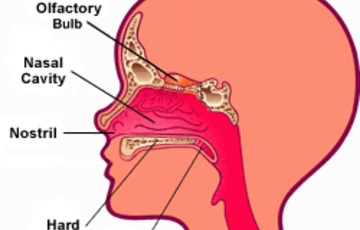
The human nose is a complex organ that serves as the primary gateway for the respiratory system and houses the sense of smell. It is divided internally into two passages by the nasal septum.
Anatomy
External Structure: The visible part of the nose is supported by bone (the nasal bone) at the top and flexible cartilage at the bottom, which forms the nostrils (nares).
Turbinates (Conchae): Three pairs of scroll-shaped bones (superior, middle, and inferior) project into the nasal cavity. These structures increase the surface area and create turbulence in the inhaled air.
Paranasal Sinuses: These are air-filled, mucous-lined cavities within the facial bones (frontal, ethmoid, sphenoid, and maxillary) that connect to the nasal cavity.
Primary Functions
The nose performs three essential functions for the body:
1. Respiration (Filtering and Conditioning Air)
The nose acts as an air conditioner and filter for inhaled air before it reaches the sensitive lungs:
Warming: Blood circulating near the surface of the turbinates warms the incoming air to body temperature.
Humidifying: The mucous lining adds moisture to the air.
Filtering: Hairs in the nostrils (vibrissae) and sticky mucus trap dust, pollen, bacteria, and other foreign particles. Tiny hair-like projections called cilia then sweep the contaminated mucus towards the throat to be swallowed or expelled.
2. Olfaction (Sense of Smell)
The sense of smell, or olfaction, is the nose's unique sensory function:
Airborne odor molecules dissolve in the mucus of the olfactory epithelium.
They bind to the olfactory receptor cells, which fire electrical signals up the olfactory nerve (Cranial Nerve I).
The signals are transmitted directly to the olfactory bulb in the brain, and from there to the limbic system (explaining the strong link between smell, memory, and emotion) and the olfactory cortex for conscious interpretation.
3. Voice Resonance
The nasal cavity and the connected paranasal sinuses act as resonating chambers, affecting the unique sound quality and tone of a person's voice.
OTHER SOURCES
Diagram of the Human Nose The external human nose, composed of bone and cartilage, is the most prominent feature of the face in humans. The internal human nose is a hollow structure above the roof of the mouth, divided by the septum into two nasal cavities that extend from the nostrils to the pharynx.
The mucous membrane that lines the nasal cavities is covered with fine hairs known as cilia that help to filter dust and impurities from the air before it reaches the lungs; the air is also moistened as it passes over the sticky nasal membrane.
In the human nose, there are three horizontal folds on the walls of the nasal cavities, called the conchae: other mammals may have more conchae.
The uppermost concha is densely supplied with capillaries that warm the air passing over them to near body temperature.
High in the nasal cavity is a small tract of mucous membrane containing the nerve cell endings of the olfactory nerve, which impart the sense of smell.
Therefore, inflammation of the nasal mucous membranes, which commonly accompanies colds and other infections, not only obstructs breathing but also impairs the sense of smell.
The human nose is much more than a facial feature—it is a highly specialized organ central to respiration, olfaction (sense of smell), immune defense, and speech resonance. Its complex structure and physiological roles make it essential for overall health and well-being.
This guide explores the anatomy, functions, and clinical significance of the human nose.
Blood supply: Branches from sphenopalatine, facial, and ophthalmic arteries.
Innervation: Trigeminal nerve for sensation; olfactory nerve for smell.
Rich vascularization warms inhaled air and plays a role in nosebleeds (epistaxis).
Functions of the Human Nose
Air Filtration: Traps dust, pollen, and microbes.
Air Conditioning: Warms and humidifies inhaled air.
Olfaction: Detects smells via the olfactory region.
Immune Defense: Mucus and cilia trap and remove pathogens.
Speech Resonance: Nasal cavity acts as a sound chamber.
Clinical Significance
Common conditions affecting the nose include:
Deviated septum: Can disrupt airflow and cause snoring or sleep apnea.
Nasal polyps: Obstruct airflow and sinus drainage.
Chronic sinusitis: Inflammation of sinuses causing congestion and pain.
Anosmia: Loss of smell due to damage or infection affecting the olfactory region.
Understanding nasal anatomy is critical for ENT specialists, respiratory therapists, and general healthcare professionals.
Conclusion
The human nose is a multifunctional organ that plays vital roles in breathing, smell, immunity, and communication. Its intricate anatomy and physiology demonstrate the remarkable design of the human body. Maintaining nasal health through proper hygiene, hydration, and medical care is essential for overall well-being.
A diagram illustrating the human nose generally encompasses both its external and internal components. On the outside, it displays the nasal bridge, tip, nares (nostrils), alae (the sides of the nostrils), and columella (the tissue that divides the nostrils). Internally, the nasal cavity is partitioned by the septum and contains turbinates (conchae) and sinuses.
The upper air passages pertain to the respiratory organs located in the human head. These include the nose and throat (pharynx).
When breathing in, air first enters through the nose, where it is initially filtered by a hair-like structure. A bifurcated network of blood vessels within the nasal mucous membrane serves to warm the incoming air. Additionally, mucous droplets from the nasal mucous membrane help to moisten the air.
This process prepares the air for the conditions found within the lungs (pulmo).
The paranasal sinuses (sinus paranasales), which are connected to the nasal cavity, also play a role in this adaptation. From the nose, the air travels to the throat, which comprises various sections, with the esophagus and windpipe intersecting in the medial throat (mesopharynx). The inhaled air continues through the throat to the larynx (larynx) and then to the lower air passages.
In contrast to the sense of taste, the sense of smell is capable of distinguishing a far greater variety of sensations. The qualitative categorization seen in taste (bitter, sweet, sour, salty) does not apply as straightforwardly to smell. Instead, scent classes are utilized to convey the experience (pungent, sweaty, rotten, etc.). The sensory receptors of the olfactory organ (organum olfactus) are situated at the beginning of the respiratory tracts and are approximately the size of a dime, located on the upper nasal wall and the septum. Due to pigmentation, the olfactory region appears yellow, which contrasts with the red membrane. It remains uncertain whether this pigmentation plays a role in the sense of smell. However, it is noted that animals lacking pigmentation (albinos) do not possess a sense of smell.
The tissue within the olfactory region, containing over 10 million receptor cells, is approximately 50 µm thicker than the epithelium of the respiratory tracts.
The olfactory cells feature very fine hairs (cilia), with up to 12 per cell, and are coated in mucus. Nerve processes from the olfactory cells bundle together as fibers leading to the anterior section of the olfactory cortex at the base of the frontal brain.
The olfactory cells are separated from the olfactory cortex by a very thin bone known as the sieve.. The olfactory cells are separated from the olfactory cortex by very thin bone, the sieve, through which the nerve fibers pass through small openings.
After appropriate processing of the olfactory information, the smell becomes known.
Olfactory cells are chemical receptors, i.e. the stimulus of the olfactory cells is the result of a chemical process on the surface of the hairs. How the molecular reaction occurs, with which hundreds of different smells are distinguished, is unclear. Gaseous substances are easier to smell. A water-soluble property increases the ability to smell because the smell molecules enter the air through evaporation.
The human nose is far more than a simple airway for breathing. It is a complex, highly specialized organ responsible for respiration, olfaction (smell), immune defense, and speech resonance. Its intricate physiology allows the body to filter, warm, humidify, and analyze the air we breathe—while simultaneously protecting the lower respiratory tract from pathogens and irritants.
This article explores the anatomy and physiology of the human nose, how it functions in health, and why it is vital to overall respiratory and neurological well-being.
Overview: What Is the Human Nose?
Physiologically, the nose is the primary entrance to the respiratory system and the sensory organ for smell. It works continuously to:
Mouth breathing bypasses these benefits and may negatively affect long-term health.
Conclusion
The physiology of the human nose reflects a remarkable balance of structure, function, and defense. Far beyond its role in breathing, the nose is a dynamic organ that conditions air, protects the body, enables smell, and contributes to communication and neurological processing.
Maintaining healthy nasal function is essential for optimal respiratory performance and overall well-being.
OTHER SOURCES
THE HUMAN NOSE
Thehuman nosehas several physiologic functions. As
the air is inspired through the nose it is humidified and warmed by passing
over the moist and warm nasal mucosa. The nose is an energy-conscious organ in
that expired air is cooled and some of the moisture is recaptured. The
functions of warming and humidification require a tremendous blood flow to the
nasal mucosa and also place substantial stress on the nasal mucosa. The nose
has what is known as a nasal cycle.
To allow the mucosa time to rest from these
functions, the nose has periods in which one side of the nose becomes swollen,
which we call congestion. During the same period the other side of the nose
remains patent or decongested. The normal nasal cycle lasts from three to six
hours, and during this time first one side of the human nose will be congested
and the other side will be patent; then the second side becomes congested as
the first side becomes patent. It is also normal for the human nose to be
congested when an individual lies down.
Particularly if you lie on your side
you may notice that the downside of your nose becomes congested. Olfaction is
the medical word for smell. Smell is one of the six human senses and for some
individuals is a very important sense; for others it seems to be less
important.
The olfactory centers, as described under the anatomy section,
reside very high along the roof of the nose. In order for these centers to be
stimulated, the odors have to be inspired into the human nose and carried up to
the roof of the human nose. If the odor does not reach the roof of the nose due
to a variety of conditions, the odor will not be perceived. The nose is capable
of distinguishing a large number of different odors. Our understanding of
precisely how this occurs is limited, but increasing.
Taste is a sense very different from olfaction. It is
another of the human senses and is perceived primarily on the tongue. There are
four recognized tastes and these are sweet, salty, sour, and bitter. They
occupy geographically separate areas on the tongue and are perceived in cells
clustered together in taste buds. The sense of smell plays a major role in the
flavor of foods and it is common for individuals who lose their sense of smell
to report that food loses its taste. This is of course incorrect; the food has
only lost its aroma, and taste (sweet, salty, sour, bitter) remains intact.
The nose is the part of the respiratory tract that sits front and center on your face. You use it to breathe air in and to stop and smell the roses. The nose’s exterior anatomy includes the nasal cavity, paranasal sinuses, nerves, blood supply, and lymphatics.
The external part of the nose includes the root (between the eyes), the dorsum that runs down the middle, and the apex at the tip of the nose. Two openings called nostrils (nares) allow air in. They’re divided by the nasal septum (dividing wall of cartilage and bone), and the parts that surround the nostrils are called the alae (ala singular).
The nose has a bony part that’s formed by the bony nasal septum, the nasal bones, and parts of the maxillae, palatine, and frontal bones. The cartilaginous part of the nose is formed by two lateral cartilages, two alar cartilages, and a septal cartilage.
The nasal cavity
The nares serve as the entryway to the nasal cavities, which open posteriorly into the nasopharynx via the choanae. The walls of the nasal cavity include the following features:
Roof: The roof is divided into three parts: frontonasal, ethmoidal, and sphenoidal. Each part corresponds to the underlying bone of the same name.
Floor: The floor consists of the palatine process of the maxilla and the horizontal plate of the palatine bone.
Medial wall: This wall is the nasal septum, which is formed by the perpendicular plate of the ethmoid bone, the vomer, cartilage, and the nasal crests of the maxillary and palatine bones.
Lateral wall: This wall is hallmarked by three nasal conchae (superior, middle, and inferior) that project inferiorly from the wall. They divide the nasal cavity into four passages that have openings to the paranasal sinuses:
The sphenoethmoid recess lies posterior to the superior concha and has the opening for the sphenoidal sinus.
The superior nasal meatus lies between the superior and middle conchae and has openings to the posterior ethmoidal sinuses.
The middle nasal meatus is longer and deeper than the superior nasal meatus. The frontal sinus communicates with the middle nasal meatus via the infundibulum, a passageway that opens into the semilunar hiatus (groove in the ethmoid bone). The maxillary sinus opens into the semilunar hiatus. An ethmoidal bulla (a round swelling formed by the middle ethmoidal cells, or air-filled cavities) is formed just above the semilunar hiatus. The middle and anterior ethmoidal sinuses drain into the middle nasal meatus.
The inferior nasal meatus is found below the inferior nasal concha. The nasolacrimal duct opens into this meatus.
The nasal cavity is lined with nasal mucosa, except for the nasal vestibule, which is lined with skin. The mucosa over the superior one-third of the nasal cavity is the olfactory area. Air is drawn past the specialized mucosal cells called the olfactory epithelium as air is sniffed though the nose.
The olfactory epithelium contains receptors of olfactory neurons that detect smells. Olfactory neurons (from CN I) join together to form nerve bundles that run up through the cribiform plate of the ethmoid bone to the olfactory bulb. The olfactory tract transmits the sensory information about smell from
The paranasal sinuses
The paranasal sinuses are air-filled cavities in the frontal, ethmoid, maxilla, and sphenoid bones. They’re lined with a mucosal membrane and have small openings into the nasal cavity:
Maxillary sinus: This sinus is located in the body of the maxilla behind the cheek just above the roots of the premolar and molar teeth. It’s shaped like a pyramid. It opens into the nasal cavity via the semilunar hiatus.
Frontal sinuses: Found within the frontal bone, each of these sinuses is triangular in shape and runs above the medial end of the eyebrow and backward to the orbit. They open into the nasal cavity via the semilunar hiatus.
Sphenoid sinuses: These sinuses are found in the sphenoid bone. Each opens into the sphenoethmoid recess.
Ethmoid sinuses: The anterior, middle, and posterior ethmoid sinuses are located in the ethmoid bone between the nose and the eye. The anterior sinus opens into the nasal cavity by the infundibulum, the middle sinus opens into the ethmoidal bulla, and the posterior sinus opens into the superior meatus.
Nerves, blood vessels, and lymphatics of the nose
Nerve supply to the external nose is provided by the infratrochlear and external nasal branches of the ophthalmic nerve and the infraorbital branch of the maxillary nerve, both of which are part of the trigeminal nerve (CN V).
The olfactory nerves (CN I) pass through the cribiform plate of the ethmoid bone. General sensory innervation of the nasal cavity and the paranasal sinuses is from the ophthalmic nerve (CN V1) and maxillary nerve (CN V2).
Blood is supplied to the external part of the nose by branches of the ophthalmic and maxillary arteries. The skin of the ala and septum are supplied by the facial artery.
Blood is brought to the walls of the nasal cavity and sinuses by branches of the maxillary artery. The most important is the sphenopalatine artery, which anastomoses with a branch of the superior labial artery. Venous blood is returned from the nasal cavity by veins that accompany the arteries.
Lymph from the nasal cavity drains into the submandibular lymph nodes and vessels that drain into the upper deep cervical lymph nodes. The Anatomy of the Nose Video :
Inside the nose is a long, air-filled chamber that extends straight back toward the throat. When you look at someone’s nostrils from outside, it seems like the space ends quickly—but it actually continues much further back in a straight line.
The average adult nasal cavity is 7–8 cm (about 3 inches) deep.
It’s shaped like a tunnel, not an upward turn the way people often imagine.
This is the space a performer uses.
2. What the Performer Is Not Doing
They are NOT piercing bone.
They are NOT entering the brain (the “brain through the nose” myth).
They are NOT going anywhere near the skull plate between the nasal cavity and the brain.
The nail simply follows the natural path of the nasal passage.
3. Why It Looks So Dramatic
Most people assume the nose turns upward right away, so the straight-back direction feels wrong.
The object is long, rigid, and looks like it must be going into solid bone, but it isn’t.
The performer’s facial expression (remaining calm) enhances the illusion that something impossible is happening.
4. Why Performers Can Do It Safely (After Training)
The physical features in a person's face are the result of the way skin, fat and muscle tissue lie over this bony structure. An exception is the human nose. The external portion of the nose is mostly cartilage and connective tissue covered with skin. Hair and mucous line the nose and protect the interior nasal passageways from dust, debris and other foreign substances.
The external portion of the nose is a little deceptive. Two nostrils appear to lead almost straight up into the nasal passageway. In reality, the nasal cavity, which connects the nose to the throat, leads almost straight back. Its ceiling is approximately even with the top of the nose, just below the eyes. Its floor tends to be almost level with the alar cartilage, which forms the openings for the nostrils.
The nasal cavity isn't entirely smooth and straight. Its walls are made up of several grooves known as conchae. These grooves hold on to moisture when you exhale through your nose, which helps keep your nasal passages from drying out. Mucous membranes line all of these surfaces, providing lubrication and protection.
The human nose is the organ of smell located in the middle of the face. The internal part of the nose lies above the roof of the mouth. The human nose consists of:
external meatus-triangular-shaped projection in the center of the face.
external nostrils-two chambers divided by the septum.
septum-made up primarily of cartilage and bone and covered by mucous membranes. The cartilage also gives shape and support to the outer part of the nose.
nasal passages-passages that are lined with mucous membranes and tiny hairs (cilia) that help to filter the air.
sinuses-four pairs of air-filled cavities, also lined with mucous membranes.
What are sinuses?
The sinuses are cavities, or air-filled pockets, near the nasal passage. As in the nasal passage, the sinuses are lined with mucous membranes. There are four different types of sinuses:
ethmoid sinus-located inside the face, around the area of the bridge of the nose. This sinus is present at birth, and continues to grow.
maxillary sinus-located inside the face, around the area of the cheeks. This sinus is also present at birth, and continues to grow.
frontal sinus-located inside the face, in the area of the forehead. This sinus does not develop until around 7 years of age.
sphenoid sinus-located deep in the face, behind the nose. This sinus does not develop until adolescence.
What is the throat?
The throat is a ring-like muscular tube that acts as the passageway for air, food, and liquid. The throat also helps in forming speech. The throat consists of:
larynx-also known as the voice box, the larynx is a cylindrical grouping of cartilage, muscles, and soft tissue which contains the vocal cords. The vocal cords are the upper opening into the windpipe (trachea), the passageway to the lungs.
epiglottis-a flap of soft tissue located just above the vocal cords. The epiglottis folds down over the vocal cords to prevent food and irritants from entering the lungs.
tonsils and adenoids-made up of lymph tissue and are located at the back and the sides of the mouth. They protect against infection, but generally have little purpose beyond childhood.
The nose is the primary organ for breathing and smelling. It also filters, warms, and humidifies the air before it reaches the lungs. It is divided into:
External nose – the visible part on the face.
Internal nose (nasal cavity) – the hollow space inside.
2. External Nose
Nasal bridge: The bony upper part of the nose.
Nostrils (nares): Openings for air entry.
Nasal tip: The protruding end of the nose.
Ala: The rounded flared sides of the nostrils.
Columella: The tissue separating the two nostrils.
3. Internal Nose (Nasal Cavity)
Nasal septum: Divides the nasal cavity into right and left sides; made of bone and cartilage.
Nasal conchae (turbinates): Superior, middle, inferior – bony curves that increase surface area for air filtration, warming, and humidification.
Meatuses: Air passages beneath each concha.
Olfactory epithelium: Located at the top; contains smell receptors.
Respiratory epithelium: Lining most of the cavity; secretes mucus to trap particles.
4. Sinuses (Paranasal Sinuses)
Hollow spaces connected to the nasal cavity:
Frontal sinus – above the eyes.
Maxillary sinus – in the cheeks.
Ethmoid sinus – between the eyes.
Sphenoid sinus – deep behind the ethmoid sinuses.
5. Functions
Breathing: Passageway for air to reach lungs.
Smelling: Houses olfactory receptors.
Air conditioning: Warms, humidifies, and filters inhaled air.
Resonance: Contributes to voice sound.
Protection: Traps dust, microbes, and other particles with mucus and cilia.
The nose is the body's primary organ of smell and also functions as part of the body's respiratory system.
Air comes into the body through the nose. As it passes over the specialized cells of the olfactory system, the brain recognizes and identifies smells. Hairs in the nose clean the air of foreign particles. As air moves through the nasal passages, it is warmed and humidified before it goes into the lungs.
The most common medical condition related to the nose is nasal congestion. This can be caused by colds or flu, allergies, or environmental factors, resulting in inflammation of the nasal passages. The body's response to congestion is to convulsively expel air through the nose by a sneeze.
Nosebleeds, known medically as epistaxis, are a second common medical issue of the nose. As many as 60 percent of people report nosebleed experiences, with the highest rates found in children under 10 and adults over 50.